
What Are Google AI Overviews and How Do You Get Your Business Featured in Them?
If you have searched Google recently, you have probably noticed a new type of result appearing at the top of the page.
Instead of showing a list of websites first, Google may display an AI-generated answer that summarises information from multiple sources across the web.
These summaries are called Google AI Overviews.
For businesses, this represents one of the biggest changes to search in years. Appearing inside an AI Overview can place your website above traditional search results and dramatically increase your visibility.
The question is: how do you get there?
This guide explains what Google AI Overviews are, how they work, how Google chooses sources and what you can do to improve your chances of being featured.
What Are Google AI Overviews?
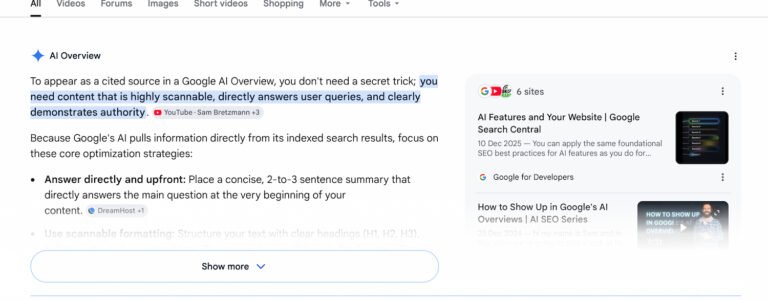
Google AI Overviews are AI-generated summaries displayed at the top of some search results. Rather than forcing users to visit multiple websites, Google combines information from several sources and creates a concise answer. The summary usually includes links to websites that Google used when generating the response. (see example in image below)
Key Facts
- Appear above traditional search results.
- Powered by Google’s AI systems.
- Include citations and source links.
- Most common for informational searches.
- Increasingly visible across Google Search.
When did Google AI Overviews launch and why did Google create them?
Google first introduced AI-generated search experiences in 2023 through its Search Generative Experience (SGE) testing programme. After extensive testing, Google began rolling out AI Overviews more widely in 2024 and has continued expanding the feature across more countries and search types.
Google created AI Overviews to help users find answers more quickly. Instead of searching multiple websites and piecing information together, users can receive a summary generated from several sources directly within the search results.
The growth of AI-powered tools such as ChatGPT, Perplexity and Gemini has also changed user expectations. People increasingly want direct answers rather than a list of links. Google AI Overviews are Google’s response to this shift in search behaviour.
However, websites still play a crucial role. AI Overviews rely on information published across the web and often provide links to the sources used. For businesses, this means creating high-quality content remains just as important as ever. The difference is that content now needs to be optimised not only for traditional rankings but also for AI-powered search experiences.
What is the difference between Google AI Overviews and AI search tools like ChatGPT or Perplexity?
Google AI Overviews and AI search tools such as ChatGPT, Perplexity and Gemini all use artificial intelligence to help users find information. However, they operate in different ways.
Google AI Overviews are built directly into Google Search. They appear above traditional search results and generate summaries using information from Google’s search index. Users still see standard search results below the AI-generated answer.
ChatGPT, Perplexity and similar AI search platforms are designed around conversation. Users ask questions, receive answers and can continue the discussion through follow-up prompts.
Another key difference is how information is presented. Google AI Overviews often focus on summarising information quickly while encouraging users to explore source websites. AI search platforms tend to provide longer responses and may answer more complex or multi-step questions.
From a business perspective, the optimisation principles are becoming increasingly similar. High-quality content, clear structure, strong expertise and topical authority can improve visibility across both Google AI Overviews and AI-powered search platforms.
This is one reason why Generative Engine Optimisation (GEO) is becoming an important extension of traditional SEO. Businesses that create genuinely helpful content are more likely to be cited across the growing range of AI search experiences.
How Do You Get Featured in Google AI Overviews?
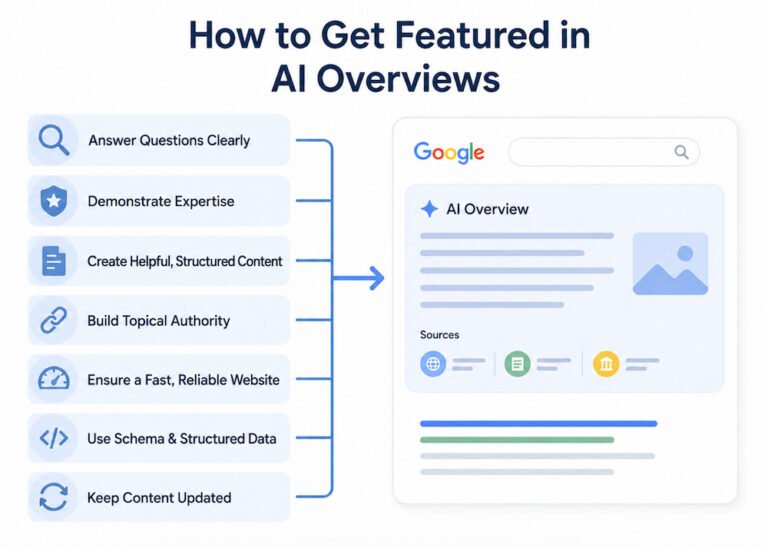
There is no application form and no guaranteed method. However, businesses that appear most often tend to have:
- Clear answers to common questions
- Strong topical authority
- Helpful, original content
- Fast, technically sound websites
- Structured headings and FAQs
- Demonstrated expertise
- Strong E-E-A-T signals
- Relevant schema markup
- Good internal linking
Google’s AI systems select sources they believe best answer a searcher’s question. Traditional rankings help, but ranking first does not guarantee inclusion.
Why Google AI Overviews Matter for Businesses
AI Overviews sit in the most prominent area of Google’s search results. When your website is cited, you can gain:
Increased Visibility
Your content may appear before the number one ranking website.
Greater Authority
Users often view cited sources as trusted references.
Qualified Traffic
Visitors arriving from AI Overviews have already received background information and are often further along in the buying journey.
AI Search Exposure
Many of the same signals that help with AI Overviews can also improve visibility in AI-powered search systems such as ChatGPT, Gemini and Perplexity.
How Does Google Choose Sources?
Google does not publish a complete formula. However, research and industry testing reveal consistent patterns.
Clear Answers Win
Pages that answer a question quickly are easier for AI systems to summarise.
Authority Matters
Google prefers sources that demonstrate expertise and trustworthiness.
Search Intent Alignment
The content must closely match the user’s question.
Structure Helps
Pages using:
- H2 headings
- H3 headings
- Bullet points
- Tables
- FAQs
are often easier for AI systems to understand.
Does Ranking Number One Guarantee Inclusion?
No. This surprises many business owners.
Recent research found that many AI Overview citations come from websites that are not ranking at the very top of Google’s organic results. In some cases, cited sources do not appear on the first page at all.
This means Google appears to use additional signals beyond traditional rankings when selecting AI Overview sources.
“AI Overviews can take the work out of searching by providing an AI-generated snapshot with key information and
links to dig deeper.” ( Source: Google)
9 Ways to Improve Your Chances of Appearing in Google AI Overviews
1. Answer Questions Directly
Start pages by answering the main question immediately.
Avoid long introductions.
2. Build Topic Clusters
Create related content around a subject.
For example, a roofing company in Surrey might create content such as:
- Roof Repairs Surrey
- New Roof Installations Surrey
- How Much Does a New Roof Cost in Surrey?
- Common Signs Your Roof Needs Repair
- Flat Roof vs Pitched Roof: Which Is Best?
Together these create topical authority.
3. Add FAQ Sections
FAQs provide highly structured information that AI systems can easily understand.
4. Demonstrate Experience
Include:
- Real examples
- Case studies
- Screenshots
- First-hand observations
5. Use Schema Markup
Schema helps search engines understand content more effectively.
6. Improve Internal Linking
Link related articles together.
7. Publish Original Insights
Unique observations often perform better than recycled information.
8. Keep Content Updated
AI systems appear to favour fresh, accurate information.
9. Build Trust Signals
Show:
- Real business details
- Reviews
- Contact information
- Author expertise
Can You Track AI Overview Performance?
Can You Track AI Overview Performance?
Yes. In June 2026, Google introduced a new Generative AI Performance report in Google Search Console. This makes it much easier for website owners to understand how their pages appear in Google’s AI-powered search results.
The report tracks impressions from both Google AI Overviews and AI Mode. In other words, you can now see how often Google displays links to your website within these AI features.
What You Can Monitor
The new report allows you to track:
AI impressions: How often links to your website appear in Google’s AI features.
Website pages: Which pages receive the most AI impressions.
Countries: Where people see your website in AI results.
Devices: Whether impressions come from desktop, tablet or mobile searches.
Performance over time: How your AI visibility changes over weeks and months.
What About Clicks?
Although the report tracks AI impressions, it does not provide separate click figures for AI Overviews or AI Mode. Google still includes these clicks in your overall Search performance data.
Also, the report combines impressions from AI Overviews and AI Mode rather than showing separate totals for each feature.
For a closer look at this new feature, read our latest article on Google Search Console’s Generative AI Performance Report.
Further Reading
For all resources related to AI and ChatGPT, read more in our related guides:
Questions our clients ask
You may find the answers to some common questions about 'AI Overviews' in the FAQs below. If you would like more information, please feel free to get in touch.
No. Google AI Overviews do not appear for every search.
Google typically displays AI Overviews when it believes an AI-generated summary will help answer a question more effectively than traditional search results alone. They are most commonly shown for informational, educational and research-based searches.
For example, a search such as “How does a heat pump work?” is more likely to trigger an AI Overview than a search for a specific website or brand name.
Google may also avoid showing AI Overviews for certain searches where accuracy is especially important, where the intent is purely navigational, or where a traditional list of results is likely to be more useful.
The appearance of AI Overviews can also vary depending on location, device, search history and Google’s ongoing testing. As a result, two users may not always see exactly the same search results.
Businesses should focus on creating content that answers common customer questions clearly and comprehensively. These are the types of searches most likely to generate AI Overviews.
Google AI Overviews are most commonly triggered by searches where users want explanations, comparisons or recommendations.
Examples include:
- How-to questions
- Product and service comparisons
- Research-based questions
- Technical explanations
- Buying guides
- Problem-solving searches
- Industry-specific questions
A search such as “What is the difference between SEO and GEO?” is far more likely to trigger an AI Overview than a search for a specific company’s homepage.
Google’s AI systems work best when they can combine information from multiple trusted sources into a concise answer. For this reason, content that explains a topic clearly, uses structured headings and answers specific questions often performs well.
Businesses should think about the questions customers ask before making an enquiry. Creating content around these questions can improve visibility in both traditional search results and AI Overviews.
“AI Mode” is Google’s more advanced AI-powered search experience. While an AI Overview provides a quick summary at the top of a search results page, AI Mode allows users to continue exploring a topic through a more conversational search journey.
When users select “Dive deeper in AI Mode”, they can ask follow-up questions, refine their search and explore related topics without starting a completely new search.
In many ways, AI Mode brings Google Search closer to the experience people have when using AI tools such as ChatGPT or Gemini. Instead of receiving a single answer, users can have an ongoing conversation around a topic.
This development highlights an important shift in search. Google is moving from simply helping users find information towards helping users understand information.
For businesses, this means content should not only answer a question but also provide context, supporting information and logical next steps. Content that demonstrates expertise and covers a topic in depth may have a greater chance of being referenced within these AI-powered experiences.
While nobody can guarantee inclusion in AI-generated results, businesses that create genuinely helpful content, demonstrate expertise and invest in long-term SEO foundations are likely to be best positioned for the future. At Surrey Web Studio, we closely follow developments in Google Search, AI Overviews, ChatGPT Search and emerging AI platforms so our clients can benefit from the latest best practices in both SEO and GEO.