
How to Get Your Business Found in ChatGPT and AI Search
Search is evolving rapidly. For many years, businesses focused mainly on appearing in Google search results. While Google remains extremely important, a new form of discovery is growing quickly. AI powered tools such as ChatGPT and other large language models are increasingly being used to research services, ask questions and find local businesses. As a result, more companies are now asking web designers not only to build a professional website, but also to ensure their business can be found and understood by AI platforms. Being visible in ChatGPT and other AI driven search tools is becoming an important part of modern online visibility, alongside traditional search engine optimisation.
Tools such as ChatGPT, Microsoft Copilot, Perplexity and Google’s AI powered search experiences are changing how people find information online. Instead of scrolling through pages of search results, many users now ask questions in natural language. AI systems then generate direct answers.
According to data shared by Google, billions of daily searches already involve complex questions where people want explanations, recommendations or guidance. Google has also reported that its AI powered search experiences are encouraging longer and more conversational queries. At the same time, hundreds of millions of people use large language models such as ChatGPT every week to research products, services and solutions.
For businesses, this shift is important. Visibility in AI systems is becoming just as important as traditional search engine optimisation.
At Surrey Web Studio, we build WordPress websites that perform well in Google search while also helping AI systems understand what your business does and where you operate.
What Is AI Search?
AI search works differently from traditional search engines.
When someone uses a traditional search engine, they usually type a short phrase such as “website designer Surrey” or “electrician near me.” The search engine then returns a list of websites, and the user chooses which one to visit.
“ChatGPT now has more than 900 million weekly active users, showing how quickly AI tools have become a major place where people research information, products and services online.”
AI tools work in a more conversational way. Instead of typing short keywords people ask questions such as:
- Who can help with funeral arrangements in Epsom?
- Can you recommend a company that delivers cakes in Worcester Park?
- Which local butcher sells organic meats?
The AI system analyses information across the internet and generates an answer. Sometimes it may mention businesses directly or refer to websites that it considers trustworthy and relevant.
Because of this change, websites need to be written and structured in a way that AI systems can easily interpret.
How AI Tools Find and Understand Businesses
AI tools such as ChatGPT, Microsoft Copilot, Perplexity and Google AI Overviews do not rely on a single database of businesses. Instead, they analyse information from across the internet to understand what a company does, where it operates and whether it appears trustworthy.
These systems look at many different signals. This can include website content, Google Business Profiles, online reviews, directory listings, structured data and mentions across the web. AI tools compare this information to build a clearer understanding of a business and its services.
Because of this, consistency is extremely important. If your website clearly explains your services, locations and business information, AI systems are far more likely to understand and trust the content. For example, your company name, contact details and service descriptions should be consistent across your website and other online platforms.
Website structure also plays an important role. Search engines and AI systems use headings, page structure and internal linking to understand how information is connected. A website with dedicated service pages, FAQs and location pages is usually much easier for AI systems to interpret than a website with very little content or unclear navigation.
Trust signals are also important. Positive reviews, clear contact information and high quality content can all help strengthen credibility. AI systems are designed to provide useful and reliable answers, so they are more likely to reference businesses that appear authoritative and well established online.
As AI powered search continues to evolve, businesses that invest in clear, well organised and trustworthy websites are likely to have a stronger chance of appearing in AI generated search results.
Why AI Visibility Matters for Local Businesses
AI powered tools are becoming a normal part of how people research services. Many users now prefer asking a question and receiving a clear explanation rather than scrolling through multiple pages of results.
Research from Google has shown that search queries are becoming longer and more conversational. Google has stated that many searches now contain five or more words, reflecting the way people ask full questions rather than using short keywords.
When people search this way they are often looking for recommendations or trusted providers. If your business website clearly explains your services and the areas you serve, AI systems are far more likely to recognise that your business is relevant.
For local businesses across Surrey this creates a major opportunity. When a potential customer asks an AI tool for advice, the systems generating those answers rely heavily on structured information found on the web. Businesses with clear, well written websites have a much greater chance of appearing in those answers
Traditional SEO vs Ai Search\GEO
| Traditional SEO | AI Search / GEO |
|---|---|
| Focuses on search rankings | Focuses on AI understanding |
| Targets keywords | Targets conversational questions |
| Users click website links | AI tools generate direct answers |
| Optimised for search engines | Optimised for AI interpretation |
| Relies heavily on rankings | Relies heavily on clarity and context |
| Short keyword phrases | Natural language questions |
| Blue link search results | AI summaries and recommendations |
The Connection Between SEO and AI Search
Many of the principles that help a website rank well in Google also help AI systems understand and reference that website. Search engines and AI models both rely on signals that indicate relevance, authority and clarity. These signals include clear website structure, high quality content, consistent service descriptions and strong local relevance.
If a website clearly explains what services a business offers and where those services are provided, both search engines and AI models can understand the information more easily. This is why modern website design needs to consider both traditional SEO and AI search visibility.
How Website Structure Helps AI Understand Your Business
One of the most important aspects of a modern website is semantic structure. Semantic structure simply means organising information so that both humans and machines can clearly understand what the content represents.
Examples include using clear headings, organising pages logically and explaining services in a straightforward way.
When a website includes structured headings, well organised service pages and clear explanations of what a business does, it becomes much easier for search engines and AI models to interpret the content.
Good website structure often includes:
- Clear heading hierarchy
- Dedicated service pages
- Location based pages
- Internal links between related content
- Frequently asked questions that answer common queries
These elements help both search engines and AI systems understand the context of a website.
What Is Generative Engine Optimisation (GEO)?
Generative Engine Optimisation, often called GEO, is the process of optimising your website so AI tools can understand, interpret and recommend your business. While traditional SEO focuses on ranking in search engine results, GEO focuses on helping your content appear in AI generated answers.
Tools such as ChatGPT, Microsoft Copilot and Perplexity AI do not simply list websites. Instead, they analyse information across the internet and generate a direct response to a question. Because of this, your website needs to communicate meaning very clearly.
GEO builds on the same foundations as SEO, but it places more emphasis on clarity, structure and context. Your content should explain what you do, who you help and where you operate in a way that is easy for both people and AI systems to understand.
How GEO Differs from Traditional SEO
Traditional SEO is mainly focused on keywords, rankings and search engine results pages. In contrast, GEO focuses on how content is interpreted and used by AI systems when they generate answers.
For example, instead of only targeting a phrase like “website design Surrey”, GEO also considers questions such as:
- Who designs websites for small businesses in Surrey?
- Which company offers WordPress website design near me?
By answering these types of questions clearly on your website, you improve your chances of being referenced by AI tools.
Why GEO Matters for Your Business
As more people use AI tools to research services, GEO is becoming an important part of online visibility. Many users now prefer asking a question and receiving a direct answer rather than clicking through multiple websites.
If your website is well structured and clearly written, AI systems are more likely to recognise your business as a relevant and trustworthy source. This can increase your visibility not only in AI generated answers, but also in traditional search results.
In simple terms, GEO helps position your business for the future of search. It ensures your website is not only found, but also understood and recommended by modern AI platforms.

“ChatGPT processes billions of queries each day, highlighting the scale at which AI powered tools are now being used for research, recommendations and problem solving.”
Local AI Visibility for Surrey Businesses
Many potential customers search online when they need a service nearby. Increasingly they are asking conversational questions such as:
- Who builds websites for businesses in Surrey?
- Which electrician fixes boilers in Sutton?
- Can you recommend a tutor near Wimbledon?
If a website clearly explains the services offered and mentions the towns and communities served, search engines and AI systems can more easily associate the business with those locations.
Local context is an important ranking signal. When a website includes references to the areas a business serves, it helps reinforce relevance for local search queries.
How Surrey Web Studio Builds AI Friendly Websites
At Surrey Web Studio we design WordPress websites that are built with modern search behaviour in mind. Our goal is to create websites that perform well in traditional search engines while also being clear and understandable for AI driven systems. Our approach includes fast and reliable WordPress websites that load quickly and perform well across devices. We organise website content carefully so search engines and AI tools can easily interpret the structure and meaning of each page. We also help businesses strengthen their local search presence by clearly identifying the towns and areas they serve.
Content is also important for ranking on AI platforms. It should be written in a way that potential customers can easily understand the services offered while also providing enough detail to demonstrate professional expertise. Websites built in this way are more likely to be recognised by search engines and AI systems as reliable sources of information.
Why Businesses Are Investing in AI Optimised Websites
A business website is no longer simply an online brochure. It is one of the most important tools for attracting new customers. A well structured website can increase visibility in search engines, improve credibility and make it easier for potential customers to contact the business. As AI driven search tools become more common, businesses that invest in clear and structured websites will be in a stronger position to benefit.
Companies that adapt early to these changes are likely to gain an advantage as search technology continues to evolve.
Preparing Your Business for the Future of Search
AI powered search is not replacing traditional search engines, but it is changing how people find information. Search behaviour is shifting towards conversational questions and intelligent summaries. Businesses that provide clear, helpful and well organised information on their websites will be easier for search engines and AI tools to understand.
By investing in a professionally designed website you position your business to appear not only in traditional search results but also in the next generation of AI driven discovery tools.
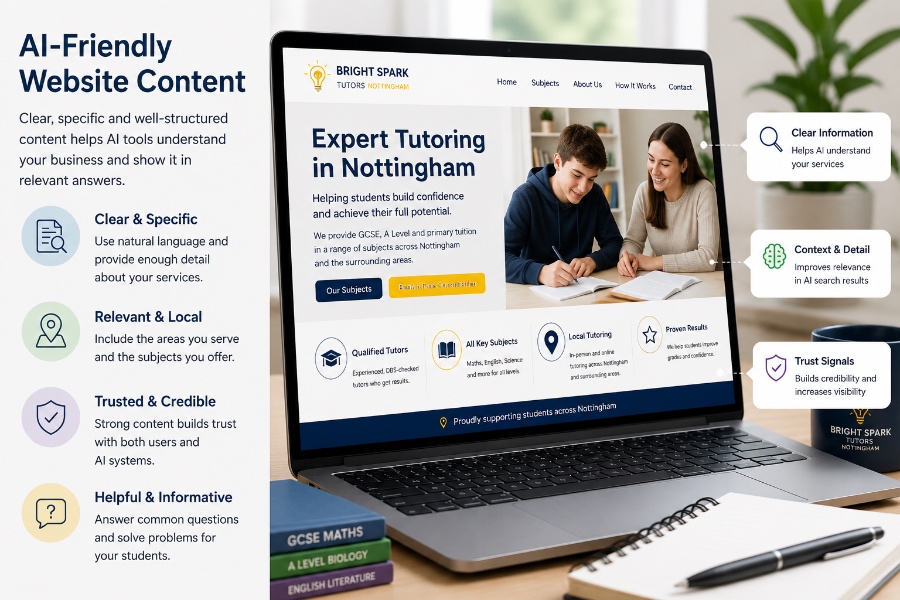
Examples of AI-Friendly Website Content
The way content is written on a website can make a big difference to how search engines and AI tools understand a business. AI systems work best when content is clear, specific and written in natural language. Vague or overly short descriptions often provide very little context, which makes it harder for AI tools to understand what services a business offers and where those services are available.
For example, a website that simply says:
“We provide electrical services.”
gives very little information. It does not clearly explain the type of work carried out, the locations served or the areas of expertise.
A more AI-friendly version would be:
“BJF Smart Home provides smart lighting installation, home automation and EV charger installation across Surrey and South West London.”
This version gives search engines and AI systems much more context. It clearly explains:
- the services provided
- the type of business
- the geographic areas covered
The same principle applies across an entire website. Dedicated service pages, FAQs, location pages and detailed explanations all help strengthen relevance and understanding.
Another example could be a tutoring company that simply says:
“We offer private tuition.”
Compared with:
“Bright Spark Tutors in Nottingham provides GCSE, A Level and primary school tutoring across Surrey, including maths, English and science tuition.”
The second example is far more descriptive and useful. It gives both users and AI systems a much clearer understanding of the services available.
In many cases, AI-friendly content is not about using complicated technical language. Instead, it is about writing clearly, answering real questions and providing enough detail for both people and AI systems to fully understand the business.

AI Search Optimisation Checklist – 15 tips to help your website get found on AI platforms
If you want your business to appear in ChatGPT and other AI-powered search tools, your website needs to be clear, structured and informative. Use this checklist as a guide to ensure your site is set up correctly.
1. Clear Website Structure
Make sure your website is easy to understand for both users and AI systems. Use one main topic per page. Organise your content with a logical structure so each page has a clear purpose.
2. Strong Heading Hierarchy
Use headings properly across your pages. Each page should have one H1, followed by H2 and H3 headings. This helps search engines and AI tools understand the meaning of your content.
3. Dedicated Service Pages
Create individual pages for each service you offer. For example, instead of one general page, have separate pages for website design, SEO, and maintenance. This improves relevance and clarity.
4. Location-Based Pages
If you serve multiple areas, create pages for each location. Clearly mention towns and regions you cover. This helps AI tools connect your business with local searches.
5. Clear Service Descriptions
Explain exactly what you do in simple language. Avoid vague wording. Make it obvious who your service is for and what problem it solves.
6. Internal Linking Between Pages
Link related pages together across your website. For example, link service pages to location pages and blog posts. This helps AI systems understand the relationships between topics.
7. Frequently Asked Questions (FAQs)
Include FAQs that answer real customer questions. Use natural language and complete sentences. This aligns with how people ask questions in AI tools.
8. Consistent Business Information
Make sure your business name, services and locations are consistent across your website. This helps search engines and AI systems trust your information.
9. Fast Loading Website
Ensure your website loads quickly on all devices. A fast website improves user experience and is a key ranking factor for search engines.
10. Mobile-Friendly Design
Your website must work well on mobile devices. Most users search on their phones, and search engines prioritise mobile usability.
11. Structured Data (Schema Markup)
Add structured data where possible, such as FAQ schema and Local Business schema. This helps search engines better understand your content and increases the chance of being featured in results.
12. High-Quality, Helpful Content
Write content that genuinely helps users. Answer questions clearly and provide useful information. AI systems favour content that demonstrates expertise and clarity.
13. Topical Authority
Build depth around your services. Create supporting content, blog posts and related pages that reinforce your expertise in a specific area.
14. Google Business Profile
Keep your Google Business Profile updated and aligned with your website. This strengthens your local visibility and supports AI recommendations.
15. Regular Content Updates
Keep your website up to date. Refresh content and add new pages over time. This shows search engines that your website is active and relevant. Once your website starts appearing in AI search results, the next step is understanding whether people are actually clicking through to your website. We have written an article to explain how to track ChatGPT and AI traffic using Google Analytics, including how to identify visits from AI platforms and measure which pages are attracting the most engagement.
Questions our clients ask
You may find the answers to some common questions about AI and website design in the FAQs below. If you would like more information, please feel free to get in touch.
AI tools such as ChatGPT analyse information from websites across the internet when generating answers. If your website clearly explains what services you offer and the areas you serve, it is more likely to be recognised as a relevant source of information. Structured content, clear headings and strong local signals help improve the chances of your business being referenced by AI systems.
Yes. AI systems rely heavily on publicly available information found on websites. A professionally designed website provides reliable information about your services and locations. This helps search engines and AI models understand what your business does and when it should be recommended to users.
AI search optimisation means structuring website content so search engines and AI systems can easily understand it. Modern tools such as ChatGPT and other large language models analyse websites to interpret, summarise and recommend information. As more people use conversational AI to research services and ask questions, businesses need websites that clearly communicate meaning, expertise and context.
A well structured website helps both search engines and AI systems understand what your business does and where you operate. This increases the chances that your website will appear in search results or be referenced when AI tools generate answers.
Clear Website Structure
In practical terms, AI search optimisation focuses on organising website content so machines can interpret it easily. A clear structure makes a significant difference. This includes using logical headings, organising pages carefully and writing clear explanations of services.
For example, a well structured website normally includes:
- A clear heading hierarchy
- Dedicated service pages
- Location based pages
- Internal links between related pages
- Frequently asked questions that answer common queries
When information is presented clearly, AI systems can quickly identify the topic of a page and understand when it may be relevant to a user’s question.
Technical Signals That Help AI Understand Content
Technical signals also play an important role in AI search optimisation. Search engines and AI models analyse many different indicators when they evaluate website content.
These signals include semantic structure, internal linking, topical relevance and overall content authority. Pages that demonstrate expertise and provide helpful information are more likely to be recognised as reliable sources.
Other elements such as structured data, content clusters and clearly written FAQs can further reinforce the meaning of a page. These signals help search engines and AI systems connect related topics across your website.
Why Clarity and Intent Matter
Another important factor is clarity of intent. Your website should clearly explain what your business does, who it serves and where it operates.
When a website communicates this information clearly, search engines and AI systems can connect it with relevant searches and recommendations. This makes it easier for potential customers to discover your business when they ask questions online.
In simple terms, AI search optimisation helps ensure that both people and intelligent systems can understand your website easily. As conversational search becomes more common, businesses that organise their content clearly will be in a stronger position to appear in both traditional search results and AI generated answers.
AI is unlikely to replace traditional search engines, but it is changing how people use them. Tools such as ChatGPT, Microsoft Copilot and Google’s AI search experiences are becoming popular ways to ask questions and research services online. However, these systems still rely heavily on information found on websites across the internet.
Search engines continue to play a central role in discovering and organising that information. They index billions of web pages and help AI systems identify reliable sources.
How AI Is Changing Search
What is changing is how people receive information. Instead of scrolling through lists of links, many users now ask conversational questions and expect a clear answer.
AI tools analyse information from trusted websites and then generate a summarised response. These answers often draw on authoritative sources and well structured website content.
Why SEO Still Matters
For businesses this means that traditional SEO remains extremely important. Search engines still need to discover, index and understand your website before AI systems can use that information.
Websites that clearly explain their services, demonstrate expertise and organise their content well are more likely to be recognised by both search engines and AI tools.
This increases the chances that your business will appear in search results or be referenced when AI systems generate answers.
The Future of Search
The future of search will most likely combine both systems. Search engines will continue to index and organise the web. AI tools will increasingly act as intelligent assistants that analyse that information and present it in a more conversational way.
Businesses that invest in clear, well structured websites will be in the best position to benefit from both traditional search results and AI driven discovery.
AI tools such as ChatGPT, Microsoft Copilot and Google’s AI powered search systems rely on well organised websites to understand information. When a website has a clear structure, it becomes easier for these systems to recognise what the business does, what services it offers and where it operates.
Clear pages help AI understand your content
A well structured website usually includes clearly named pages, logical headings and organised content. Each page focuses on a specific topic or service. This helps both search engines and AI platforms understand the purpose of the page and when it might be relevant to someone searching for that information.
For example, a page that clearly explains website design services in Guildford will be easier for search engines and AI systems to interpret than a page that mixes several topics together without clear headings or structure.
Good structure improves search visibility
Website structure has always been important for traditional search engines such as Google. Pages that are clearly organised, easy to navigate and focused on specific topics are easier for Google to crawl and index. The same principles also help AI tools understand which websites provide reliable information about a particular subject.
When your website has a logical structure, clear headings and useful content, it becomes easier for search engines and AI platforms to identify your expertise and reference your website when people search for related services.
A strong foundation for future search
Search technology continues to evolve, but clear website structure remains one of the most important foundations of good SEO. Businesses that organise their websites well are more likely to appear in Google search results and to be recognised by newer AI driven search tools that help people research services online.
Schema markup is a type of structured data that helps search engines understand your content more clearly. It uses a standard format, often based on Schema.org, to label information such as services, locations and FAQs.
For example, you can mark up your business as a local company, define your services or highlight questions and answers. This gives search engines additional context beyond the visible text on the page.
While AI tools do not rely only on schema, it still plays an important role. Search engines like Google use structured data to interpret content more accurately. AI systems often depend on this indexed information when generating answers.
In simple terms, schema helps machines understand what your content means, not just what it says. When combined with clear writing and strong structure, it can improve your chances of being recognised as a reliable source.
Yes, it is possible. AI tools such as ChatGPT and Perplexity AI do not always select only the top-ranking websites. Instead, they analyse a range of sources to find the most relevant and useful information.
This means a well-written and clearly structured website can still be referenced, even if it is not ranking at the very top of Google.
However, strong SEO still plays an important role. Search engines help surface and validate content across the web. If your website is well indexed, trusted and relevant, it is more likely to be picked up by AI systems.
In practice, the best results come from combining both. A website that ranks well in Google and is clearly written for users will have the highest chance of appearing in AI generated answers.
Internal linking is the process of connecting pages within your website. For example, you might link a service page to related location pages or blog articles.
This helps search engines and AI systems understand how your content is connected. It also shows which pages are most important and how different topics relate to each other.
For instance, if your website design page links to pages about SEO and local services, it reinforces your expertise in that area. Over time, this builds a clearer picture of your business.
Internal links also improve navigation for users, which keeps people on your site for longer. This is another positive signal for search engines.
In simple terms, internal linking helps create structure and context. This makes it easier for AI tools to interpret your website and decide when it is relevant to a user’s question.
AI tools such as ChatGPT aim to provide useful, relevant and trustworthy answers. To do this, they analyse information from across the internet to understand what a business does and whether it appears reliable.
Several factors can influence whether a business is mentioned in AI generated answers. These include clear website content, strong local relevance, positive reviews, structured website pages and consistent business information across the web.
For example, a website that clearly explains its services, locations and expertise is much easier for AI systems to understand than a website with very little information. FAQs, service pages and location based content can also help improve clarity.
Trust is important as well. Businesses with positive reviews, professional websites and helpful content are more likely to appear credible to both users and AI systems.
While no business can guarantee visibility in AI search results, a clear and well structured website gives AI tools much more information to work with.
Yes. A Google Business Profile can play an important role in both traditional local SEO and AI visibility.
Google Business Profiles provide useful information about a business, including services, opening hours, reviews, contact details and locations served. AI systems and search engines use this information to better understand local businesses.
A complete and regularly updated profile can help strengthen trust and local relevance. Positive reviews, accurate contact details and clear service descriptions all help reinforce credibility online.
It is also important that your Google Business Profile matches the information on your website. Consistent business names, phone numbers and service descriptions help search engines and AI systems trust the information more easily.
For local businesses, a strong Google Business Profile remains one of the most important parts of online visibility.
AI systems tend to favour content that is clear, helpful and easy to understand. Websites that answer real questions and explain services in simple language are often much easier for AI tools to interpret.
Content that performs well in AI search often includes:
- dedicated service pages
- FAQs
- location based content
- helpful guides and articles
- clear headings and structure
Natural language is also important. Many people now search using full questions rather than short keywords. Because of this, websites should be written in a conversational and informative way.
For example, a page that clearly explains “smart lighting installation in Surrey” is likely to provide more useful context than a vague page with very little detail.
The goal is not to overload a page with keywords. Instead, businesses should focus on creating useful content that genuinely helps users while clearly explaining what the business offers and where it operates.